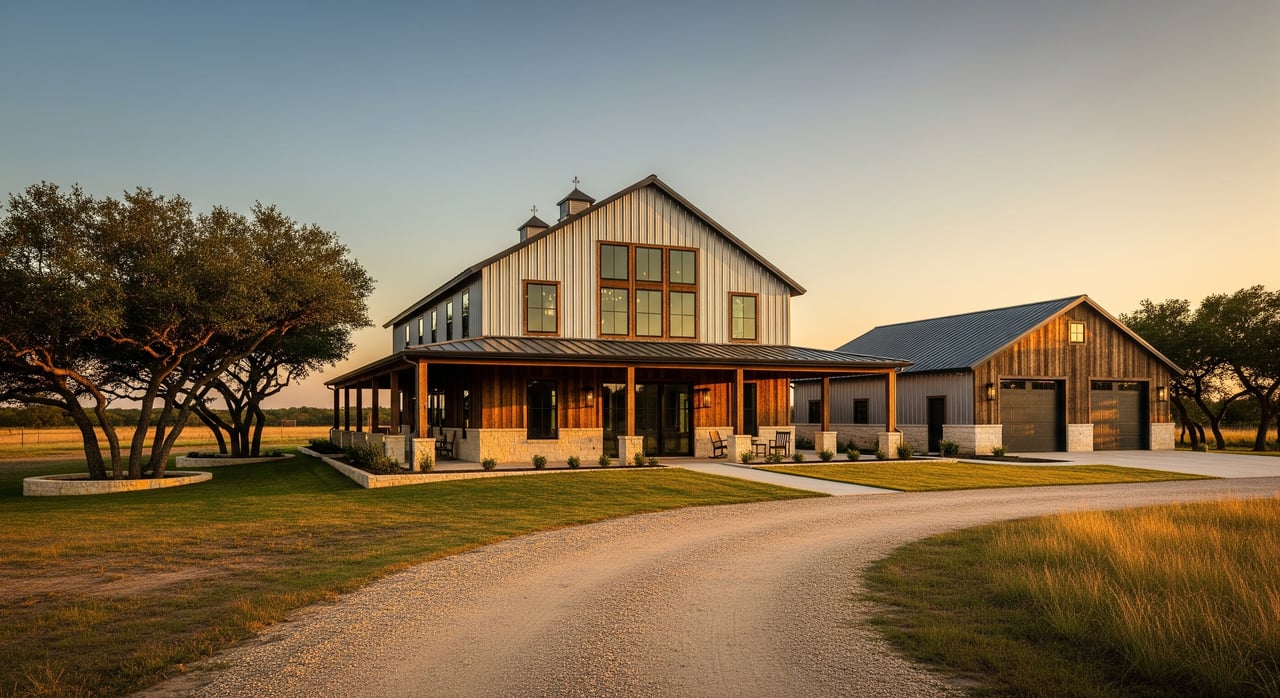
Dreaming of big shop space and open-concept living on land near Pilot Point? A barndominium can deliver that flexible lifestyle, but the path from idea to move-in is different from a traditional home. You want clear numbers, a lender who understands metal builds, and a clean plan for permits and inspections. This guide walks you through costs, financing options, codes, and the local steps that matter in Denton County so you can move forward with confidence. Let’s dive in.
What a barndominium is
A barndominium is a residence that combines a metal or post-frame shell with finished living space inside. Common approaches include a post-frame structure with metal siding and roof, a pre-fabricated steel building with stick-framed rooms inside, or a hybrid that blends both. People like these projects for the large, open interiors and potentially faster shell construction.
For financing and permits, the critical question is how your project is classified. If it is permitted as a single-family residence on a permanent foundation and inspected to residential code, lenders and insurers typically treat it like a home. If it is permitted as an agricultural or shop building with incidental living quarters, you may face limited loan and insurance options and a narrower resale market.
Realistic costs in Pilot Point
Every site is different, and finishes vary. Use these North Texas planning ranges, then confirm with local quotes.
- Shell (post-frame or steel kit, erected): commonly $30–$75 per sq ft. Premium spans, thicker steel, and more openings increase cost.
- Interior finish (drywall, floors, kitchen/bath, fixtures): additional $50–$150+ per sq ft depending on finish level. Combined budgets often land roughly $80–$225+ per sq ft.
- Foundation: about $6–$25+ per sq ft depending on slab type and soils.
- Site work and driveway: roughly $3,000–$25,000+ depending on clearing, grading, and access.
- Well: typically $4,000–$15,000+ based on depth and geology.
- Septic: usually $5,000–$20,000+ depending on soil tests and system type.
- Utility extensions: a few hundred dollars to $10,000–$50,000+ when lines or a transformer are needed. Get electric estimates from the local distributor and ask the gas provider about service availability.
- HVAC and insulation: about $8,000–$30,000+ depending on system size and insulation approach. Proper condensation control is essential for metal shells.
- Permits and inspections: plan for several hundred to several thousand dollars depending on jurisdiction.
- Contingency: reserve 10–20% of your construction budget.
Cost drivers include steel and lumber pricing, DFW labor availability, soil conditions, distance to utilities, and your chosen finish level. In practice, basic utility finishes reduce cost, while high-end kitchens, large covered porches, and complex layouts push budgets to the top of the range.
Financing and lenders that fit barndominiums
You have several paths, and the right one depends on your builder, budget, and how the project is permitted.
- Construction-to-permanent loans: one closing that converts to a mortgage at completion. Many buyers like the simplicity.
- Construction-only loans: short-term financing during the build, followed by a separate mortgage.
- Conventional construction loans: often available through portfolio lenders and local banks for single-family homes, including barndominiums permitted as residences.
- Government-backed options: USDA programs can work in rural areas if the property and your income meet rules. FHA and VA also have construction options offered through approved lenders, each with requirements around builder licensing, plans, and appraisal.
Helpful resources:
- Review rural loan programs on the USDA Rural Development Texas page for location and income eligibility.
- See HUD’s Single Family Housing resources for FHA program guidance.
- Learn about VA home loan benefits and construction considerations on the VA site.
Practical tips for Pilot Point buyers:
- Start with local community banks and credit unions and ask if they have closed barndominium loans recently. Lender familiarity helps.
- Confirm the structure will be permitted as a residence on a permanent foundation. That classification supports both underwriting and insurance.
- Ask how the lender will handle appraisal when comparable sales are limited. Appraisers who understand post-frame or metal homes often make the process smoother.
- Expect a licensed general contractor, stamped plans and specifications, and a fixed-price or guaranteed maximum contract in many cases.
- Plan for higher down payments on construction loans, often around 20% or more, depending on the program.
Codes, permits, and inspections in Pilot Point
Rules change by location, so verify early. If your lot is inside city limits, contact the City of Pilot Point for zoning, setbacks, and whether metal buildings are allowed as primary residences in your zoning district. If you are outside city limits, check Denton County’s environmental health department for septic and well approvals and ask about any county permitting steps.
- Start with the City of Pilot Point for zoning, building permits, and city utilities.
- For rural parcels, visit Denton County for septic approvals and county rules.
- If your tract is near creeks or low areas, use the FEMA Flood Map Service Center to see if special elevation or flood insurance rules apply.
Typical permit and inspection sequence:
- Pre-application: confirm zoning and check any deed covenants that limit metal exteriors or require specific architectural standards.
- Plan review: submit building plans and a site plan showing setbacks, driveway, and septic or well locations.
- Site work and foundation permits, then foundation inspection.
- Framing, electrical, plumbing, and mechanical permits, with sequential inspections.
- Final inspections and, where required, a certificate of occupancy.
- Separate septic and well inspections and approvals through the county for rural builds.
Classification matters for your budget and financing. A single-family dwelling permitted to residential code typically supports conventional mortgages and standard homeowners insurance. A structure permitted as an agricultural or shop building with living quarters may limit your lending and insurance choices.
Land, utilities, and site logistics that add cost
Utility access is often the biggest swing factor after finishes. Get clarity before you buy.
- Water: Public water may be available near town, with connection or line-extension fees. Rural lots often use private wells that require drilling, a pump system, and water quality testing.
- Sewer or septic: Some areas have public sewer. Many rural tracts require a septic system sized by soil tests; soils and water table drive cost and design.
- Electric: Contact Oncor Electric Delivery for service and any line extension or transformer costs. Long runs to the road can be expensive.
- Gas: Check availability with Atmos Energy. If no natural gas line is nearby, plan for propane.
- Broadband: Fiber and high-speed options vary. Remote tracts may rely on fixed wireless or satellite.
Insurance, appraisal, and resale
Insurers vary in how they price and underwrite metal or post-frame homes. Many carriers will want proof of code-compliant electrical, plumbing, smoke alarms, and any required fire-rated separation between shop and living areas. Shop coverage with agents who understand post-frame construction.
For appraisals, comparable sales can be limited. Documentation around your plans, finishes, and permanent foundation helps support value. Clear classification as a single-family residence and higher-quality finishes typically aid resale, though the buyer pool can be more specialized than for traditional homes.
Timeline and builder selection
Build timelines depend on your site, kit lead times, and finish complexity. A common sequence is 2–8 weeks for site work and foundation, days to a few weeks to erect the shell, and 2–6+ months for interior finish. Many projects run 3–9 months overall, sometimes longer in busy markets.
Choose a builder with barndominium or post-frame residential experience and familiarity with local permitting. Get multiple bids, confirm insurance, review references, and aim for a fixed-price or guaranteed maximum contract. Keep a 10–20% contingency for materials or site surprises.
Your next steps checklist
- Verify zoning and any deed covenants for your specific lot with the City of Pilot Point or Denton County.
- Confirm electric, gas, and water service availability and get line-extension estimates. Contact Oncor and Atmos early for realistic numbers.
- Order a septic soil test and assess well feasibility if the property is not on public utilities.
- Develop preliminary site and floor plans that specify foundation and insulation approaches.
- Speak with at least two lenders about construction financing, appraisal expectations, and builder requirements.
- Check FEMA flood maps and any site constraints that could affect costs or insurance.
- Price insurance with agents who understand metal and post-frame homes.
- Set a budget with a contingency and plan for material lead times.
Thinking about a lot around Pilot Point and want a second opinion on feasibility and budget fit? Our local team helps buyers evaluate land, understand utility and permitting steps, and line up the right conversations with lenders and contractors. When you are ready, connect with Lake & Country Realty® for guidance tailored to barndominiums and acreage in North Texas.
FAQs
Can you get a mortgage for a barndominium in Pilot Point?
- Yes, when it is permitted and built as a single-family residence on a permanent foundation, and you use a lender familiar with metal or post-frame homes; expect appraisal documentation and a licensed builder.
What does a finished barndominium cost per square foot in North Texas?
- Planning ranges often run about $80–$225+ per sq ft depending on shell type, finishes, site conditions, utilities, and insulation and HVAC choices; local contractor quotes are essential.
Which permits and inspections are required inside Pilot Point city limits?
- Expect plan review, building permits, and staged inspections for foundation, framing, electrical, plumbing, and mechanical, plus final inspections and a certificate of occupancy where required; confirm details with the city.
How do utilities typically work for rural barndominiums in Denton County?
- Many rural builds use a private well and septic, with electric from the local distributor and gas from a regional provider or propane; availability and line extensions can add significant cost.
Will classifying my build as a shop with living quarters affect financing and insurance?
- Often yes; agricultural or shop classifications may limit mortgage and insurance options, while a dwelling permitted to residential code usually supports conventional financing and standard coverage.
How long does a barndominium build usually take in North Texas?
- Many projects finish in about 3–9 months, with 2–8 weeks for site work and foundation, days to a few weeks for shell erection, and 2–6+ months for interior finish depending on scope.